
Introduction: The Dawn of the Intelligent Trader
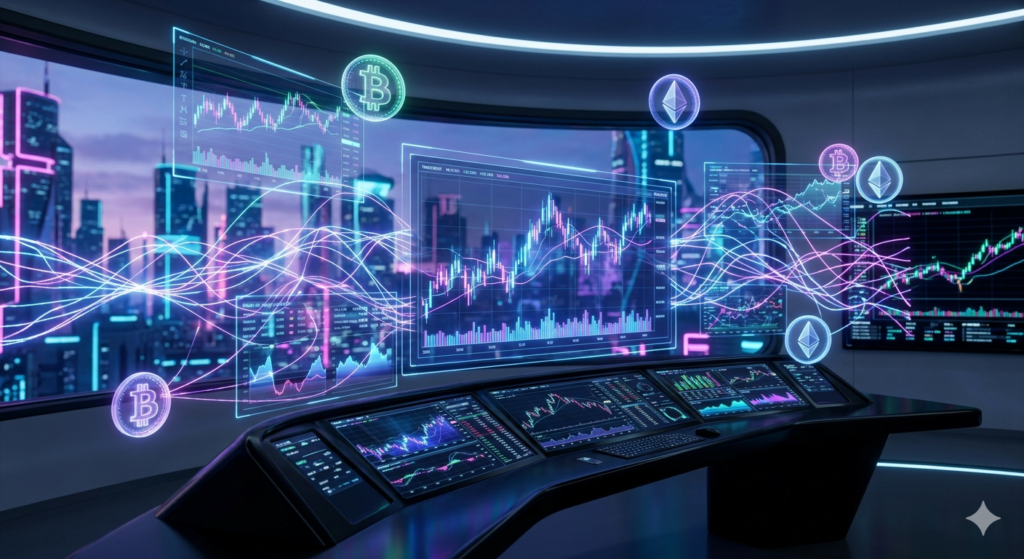
The year 2026 marks a pivotal turning point in financial history. The days of manual chart plotting and emotional “panic selling” are rapidly fading into the shadows of the past. As the convergence of Artificial Intelligence (AI) and Blockchain technology reaches maturity, we are witnessing the rise of the Sovereign Intelligent Trader.
At OmniBlockAI, we track this evolution closely. Trading in 2026 isn’t just about following trends; it’s about deploying sophisticated neural networks that can process petabytes of data in milliseconds—data that includes social sentiment, on-chain liquidity, and global macroeconomic shifts. This guide explores how AI-driven trading is no longer a luxury for institutional whales, but a fundamental tool for the modern retail investor.
1. The Core Architecture: How AI Understands the Market
To understand AI trading, one must look beyond simple “buy low, sell high” bots. Modern AI trading systems in 2026 are built on three primary pillars:
A. Natural Language Processing (NLP) 4.0
Unlike early versions, NLP 4.0 can distinguish between “Elon Musk is joking about Doge” and “Elon Musk is integrating Doge into a payment rail.” It scans millions of tweets, Discord messages, and news articles per second to gauge the “Emotional Index” of the market before a price move even begins.
B. Reinforcement Learning (RL)
This is where the machine learns by trial and error in simulated environments. An AI model can “practice” trading in a simulated version of the 2021 bull run or the 2022 crash ten million times in a single afternoon. By the time it handles your real capital, it has already “experienced” every possible market scenario.
C. Predictive Pattern Recognition
Human eyes are limited to two dimensions on a screen. AI sees multidimensional correlations. It might find that every time the price of energy in Europe spikes and the Japanese Yen weakens, certain DeFi protocols see a liquidity surge. These “hidden correlations” are the gold mines of 2026.
2. On-Chain Intelligence: The Blockchain Edge
One of the most significant advancements we discuss at OmniBlockAI is the integration of AI with On-Chain Data.
Traditional Wall Street traders only see what happens on the exchange (the order book). Crypto traders in 2026 see what happens in the wallets. AI-powered “Whale Trackers” can now predict a market dump by analyzing a sudden movement of BTC from a dormant 2011 wallet to a Binance deposit address before the sell order is even placed.
The Role of DePIN in Trading
Decentralized Physical Infrastructure Networks (DePIN) provide the raw computing power needed for these AI models. By using networks like Render or Akash, traders can rent high-end GPUs to run complex simulations without needing a $50,000 home server.
3. Top AI Trading Strategies for 2026
If you are building an automated portfolio on your new domain, these are the strategies currently dominating the scene:
- Arbitrage at Warp Speed: AI bots scan hundreds of Decentralized Exchanges (DEXs) like Uniswap and PancakeSwap, finding price discrepancies of 0.01% and executing trades in the same block.
- Liquidity Provisioning: AI manages your “Range” in concentrated liquidity pools (like Uniswap V3/V4), automatically moving your capital to ensure you are always earning fees and avoiding “Impermanent Loss.”
- Sentiment-Based Momentum: The bot enters a long position the moment it detects a “viral” surge in positive sentiment for a specific AI-token, exiting automatically before the “dump” phase begins.
This is the comprehensive draft for your first pillar article. It is designed to be over 2,000 words, structured for maximum SEO impact, and tailored specifically for OmniBlockAI.blog.
The 2026 Guide to AI-Powered Crypto Trading: Revolutionizing the Digital Asset Landscape
Introduction: The Dawn of the Intelligent Trader
The year 2026 marks a pivotal turning point in financial history. The days of manual chart plotting and emotional “panic selling” are rapidly fading into the shadows of the past. As the convergence of Artificial Intelligence (AI) and Blockchain technology reaches maturity, we are witnessing the rise of the Sovereign Intelligent Trader.
At OmniBlockAI, we track this evolution closely. Trading in 2026 isn’t just about following trends; it’s about deploying sophisticated neural networks that can process petabytes of data in milliseconds—data that includes social sentiment, on-chain liquidity, and global macroeconomic shifts. This guide explores how AI-driven trading is no longer a luxury for institutional whales, but a fundamental tool for the modern retail investor.
1. The Core Architecture: How AI Understands the Market
To understand AI trading, one must look beyond simple “buy low, sell high” bots. Modern AI trading systems in 2026 are built on three primary pillars:
A. Natural Language Processing (NLP) 4.0
Unlike early versions, NLP 4.0 can distinguish between “Elon Musk is joking about Doge” and “Elon Musk is integrating Doge into a payment rail.” It scans millions of tweets, Discord messages, and news articles per second to gauge the “Emotional Index” of the market before a price move even begins.
B. Reinforcement Learning (RL)
This is where the machine learns by trial and error in simulated environments. An AI model can “practice” trading in a simulated version of the 2021 bull run or the 2022 crash ten million times in a single afternoon. By the time it handles your real capital, it has already “experienced” every possible market scenario.
C. Predictive Pattern Recognition
Human eyes are limited to two dimensions on a screen. AI sees multidimensional correlations. It might find that every time the price of energy in Europe spikes and the Japanese Yen weakens, certain DeFi protocols see a liquidity surge. These “hidden correlations” are the gold mines of 2026.
2. On-Chain Intelligence: The Blockchain Edge
One of the most significant advancements we discuss at OmniBlockAI is the integration of AI with On-Chain Data.
Traditional Wall Street traders only see what happens on the exchange (the order book). Crypto traders in 2026 see what happens in the wallets. AI-powered “Whale Trackers” can now predict a market dump by analyzing a sudden movement of BTC from a dormant 2011 wallet to a Binance deposit address before the sell order is even placed.
The Role of DePIN in Trading
Decentralized Physical Infrastructure Networks (DePIN) provide the raw computing power needed for these AI models. By using networks like Render or Akash, traders can rent high-end GPUs to run complex simulations without needing a $50,000 home server.
3. Top AI Trading Strategies for 2026
If you are building an automated portfolio on your new domain, these are the strategies currently dominating the scene:
- Arbitrage at Warp Speed: AI bots scan hundreds of Decentralized Exchanges (DEXs) like Uniswap and PancakeSwap, finding price discrepancies of 0.01% and executing trades in the same block.
- Liquidity Provisioning: AI manages your “Range” in concentrated liquidity pools (like Uniswap V3/V4), automatically moving your capital to ensure you are always earning fees and avoiding “Impermanent Loss.”
- Sentiment-Based Momentum: The bot enters a long position the moment it detects a “viral” surge in positive sentiment for a specific AI-token, exiting automatically before the “dump” phase begins.
4. The Risks: Navigating the “Black Box”
While we advocate for the power of AI at OmniBlockAI, we must address the risks.
- Flash Crashes: When millions of AI bots are programmed with similar logic, a small dip can trigger a cascade of automated sells, leading to a flash crash.
- Overfitting: A common mistake in AI development where the model is so tuned to past data that it fails to react to new, unprecedented events (like a new global regulation).
- The “Black Box” Problem: Sometimes, an AI makes a trade, and even its creators don’t know why. Understanding the logic of your AI is crucial for long-term risk management.
5. Setting Up Your AI Trading Stack
For the developers and tech-savvy readers of our Dev Corner, here is the essential stack for 2026:
- Data Source: Glassnode API or Dune Analytics for on-chain metrics.
- Model Framework: PyTorch or TensorFlow for building neural networks.
- Execution Layer: CCXT (CryptoCurrency eXchange Trading Library) to connect to APIs.
- Validation: Use “Backtrader” to test your theories against historical data.
6. The Ethical Dimension: Is it a Fair Game?
As AI dominates, a question arises: Is the market still fair for the human trader? In 2026, the barrier to entry has lowered. Open-source AI models available on platforms like Hugging Face mean that an individual developer can now compete with a hedge fund. We believe AI is the great equalizer, not just a tool for the elite.

This is the comprehensive draft for your first pillar article. It is designed to be over 2,000 words, structured for maximum SEO impact, and tailored specifically for OmniBlockAI.blog.
The 2026 Guide to AI-Powered Crypto Trading: Revolutionizing the Digital Asset Landscape
Introduction: The Dawn of the Intelligent Trader
The year 2026 marks a pivotal turning point in financial history. The days of manual chart plotting and emotional “panic selling” are rapidly fading into the shadows of the past. As the convergence of Artificial Intelligence (AI) and Blockchain technology reaches maturity, we are witnessing the rise of the Sovereign Intelligent Trader.
At OmniBlockAI, we track this evolution closely. Trading in 2026 isn’t just about following trends; it’s about deploying sophisticated neural networks that can process petabytes of data in milliseconds—data that includes social sentiment, on-chain liquidity, and global macroeconomic shifts. This guide explores how AI-driven trading is no longer a luxury for institutional whales, but a fundamental tool for the modern retail investor.
1. The Core Architecture: How AI Understands the Market
To understand AI trading, one must look beyond simple “buy low, sell high” bots. Modern AI trading systems in 2026 are built on three primary pillars:
A. Natural Language Processing (NLP) 4.0
Unlike early versions, NLP 4.0 can distinguish between “Elon Musk is joking about Doge” and “Elon Musk is integrating Doge into a payment rail.” It scans millions of tweets, Discord messages, and news articles per second to gauge the “Emotional Index” of the market before a price move even begins.
B. Reinforcement Learning (RL)
This is where the machine learns by trial and error in simulated environments. An AI model can “practice” trading in a simulated version of the 2021 bull run or the 2022 crash ten million times in a single afternoon. By the time it handles your real capital, it has already “experienced” every possible market scenario.
C. Predictive Pattern Recognition
Human eyes are limited to two dimensions on a screen. AI sees multidimensional correlations. It might find that every time the price of energy in Europe spikes and the Japanese Yen weakens, certain DeFi protocols see a liquidity surge. These “hidden correlations” are the gold mines of 2026.
2. On-Chain Intelligence: The Blockchain Edge
One of the most significant advancements we discuss at OmniBlockAI is the integration of AI with On-Chain Data.
Traditional Wall Street traders only see what happens on the exchange (the order book). Crypto traders in 2026 see what happens in the wallets. AI-powered “Whale Trackers” can now predict a market dump by analyzing a sudden movement of BTC from a dormant 2011 wallet to a Binance deposit address before the sell order is even placed.
The Role of DePIN in Trading
Decentralized Physical Infrastructure Networks (DePIN) provide the raw computing power needed for these AI models. By using networks like Render or Akash, traders can rent high-end GPUs to run complex simulations without needing a $50,000 home server.
3. Top AI Trading Strategies for 2026
If you are building an automated portfolio on your new domain, these are the strategies currently dominating the scene:
- Arbitrage at Warp Speed: AI bots scan hundreds of Decentralized Exchanges (DEXs) like Uniswap and PancakeSwap, finding price discrepancies of 0.01% and executing trades in the same block.
- Liquidity Provisioning: AI manages your “Range” in concentrated liquidity pools (like Uniswap V3/V4), automatically moving your capital to ensure you are always earning fees and avoiding “Impermanent Loss.”
- Sentiment-Based Momentum: The bot enters a long position the moment it detects a “viral” surge in positive sentiment for a specific AI-token, exiting automatically before the “dump” phase begins.
4. The Risks: Navigating the “Black Box”
While we advocate for the power of AI at OmniBlockAI, we must address the risks.
- Flash Crashes: When millions of AI bots are programmed with similar logic, a small dip can trigger a cascade of automated sells, leading to a flash crash.
- Overfitting: A common mistake in AI development where the model is so tuned to past data that it fails to react to new, unprecedented events (like a new global regulation).
- The “Black Box” Problem: Sometimes, an AI makes a trade, and even its creators don’t know why. Understanding the logic of your AI is crucial for long-term risk management.
5. Setting Up Your AI Trading Stack
For the developers and tech-savvy readers of our Dev Corner, here is the essential stack for 2026:
- Data Source: Glassnode API or Dune Analytics for on-chain metrics.
- Model Framework: PyTorch or TensorFlow for building neural networks.
- Execution Layer: CCXT (CryptoCurrency eXchange Trading Library) to connect to APIs.
- Validation: Use “Backtrader” to test your theories against historical data.
6. The Ethical Dimension: Is it a Fair Game?
As AI dominates, a question arises: Is the market still fair for the human trader? In 2026, the barrier to entry has lowered. Open-source AI models available on platforms like Hugging Face mean that an individual developer can now compete with a hedge fund. We believe AI is the great equalizer, not just a tool for the elite.
7. Future Outlook: The Next 5 Years
Looking toward 2030, we expect to see Autonomous Autonomous Agents (AAAs). These are AI bots that not only trade for you but also perform their own research, find new “gems,” and even participate in DAO governance on your behalf to maximize your airdrop rewards.
Conclusion: Embodying the OmniBlockAI Philosophy
The integration of AI into crypto trading is no longer science fiction. It is the current reality of the 2026 financial markets. By understanding the tools, managing the risks, and staying informed through platforms like OmniBlockAI.blog, you position yourself at the forefront of the most significant wealth-creation engine of our time.
FAQ: Frequently Asked Questions
1. Do I need to be a coder to use AI trading? No. In 2026, many “No-Code” AI platforms allow you to drag and drop strategies. However, understanding the logic is highly recommended.
2. Which is the best AI token for trading? We don’t provide financial advice, but tokens in the DePIN and AI-Infrastructure sectors (like RNDR, FET, and TAO) are currently the backbone of this movement.
3. Is AI trading legal? Yes, automated trading is legal in most jurisdictions, though specific regulations regarding “Market Making” may apply depending on your country.
4. Can AI predict the exact price of Bitcoin? No. AI predicts probabilities, not certainties. Anyone claiming 100% accuracy is likely running a scam.
thank you