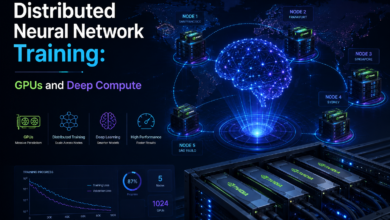
Distributed Neural Network Training: GPUs and Deep Compute

The pursuit of artificial intelligence has led to remarkable advancements in machine learning, particularly with the advent of deep neural networks. Training these complex models, however, presents significant computational challenges. This article delves into the strategies and technologies, such as GPUs and distributed computing, that enable efficient and scalable neural network training, transforming the landscape of AI development.
Understanding Neural Networks
What are Neural Networks?
Neural networks are a fundamental component of modern machine learning and are inspired by the structure and function of the human brain. At their core, a neural network consists of interconnected nodes, often organized in layers, that process information. Each connection between nodes has an associated weight, and each node has an activation function. When data is fed into the network, it propagates through these layers, with each node performing a computation and passing its output to the subsequent nodes. The ultimate goal of neural network training is to adjust these weights and biases so that the network can accurately perform a specific task, such as image recognition or natural language processing, by minimizing a loss value.
Architecture of Deep Neural Networks
The architecture of deep neural networks is characterized by having multiple hidden layers between the input and output layers, enabling them to learn hierarchical representations of data. This deep architecture allows for the extraction of increasingly abstract features, which is crucial for tackling complex problems in machine learning. Different types of deep neural networks exist, such as convolutional neural networks (CNNs) for image processing and recurrent neural networks (RNNs) for sequential data, each with a specialized architecture. The complexity of these networks, often involving millions or even billions of parameters, makes their training computationally intensive, necessitating powerful compute resources and efficient optimization techniques like gradient descent.
Applications in Machine Learning
The versatility of neural networks has led to their widespread application across numerous domains in machine learning. From powering recommendation systems and autonomous vehicles to enabling sophisticated medical diagnostics and natural language understanding, deep learning models are at the forefront of innovation. Their ability to learn intricate patterns and make highly accurate predictions from vast datasets makes them indispensable tools in data science. The continuous improvement in neural network training techniques and the availability of more powerful compute infrastructure, particularly GPUs, continues to expand the horizons of what is achievable with these transformative technologies, driving progress in various industries.
Distributed Computing in Neural Network Training
Distributed computing has emerged as a critical paradigm for accelerating neural network training, especially when dealing with large models and extensive datasets. This approach involves distributing the computational workload across multiple compute nodes, often configured in a cluster, to collectively process the data and update the model parameters. The core idea is to break down the intensive computation required for deep neural networks into smaller, manageable tasks that can be executed in parallel. This distributed processing significantly reduces the overall training time, making it feasible to train increasingly complex neural architectures that would be impractical on a single machine, thus advancing the capabilities of machine learning and deep learning applications.
Benefits of Distributed Neural Network Training
The advantages of distributed neural network training are substantial, particularly concerning scalability and efficiency in the training process.
By distributing the workload across multiple GPUs or CPUs within a distributed system, it offers several key benefits:
| Benefit | Description |
| Scalability | Handles larger datasets and trains more complex deep neural networks with billions of parameters. |
| Efficiency | Dramatically reduces overall computation time, allowing faster iteration on model development and better performance. |
| Fault Tolerance | Failure of a single node does not necessarily halt the entire training process, contributing to a more robust and reliable machine learning pipeline. |
| Optimization | Enables sophisticated optimization techniques to be applied more effectively, leading to lower loss values and improved model generalization. |
Challenges in Distributed Computing
Despite its benefits, distributed computing for neural network training presents several inherent challenges that must be carefully addressed. One significant bottleneck is the communication overhead between compute nodes, as gradients and model parameters need to be exchanged frequently to ensure the consistency of the global model. This communication can be particularly costly when dealing with a large model or a cluster with a high number of GPUs or servers. Furthermore, managing the synchronization of model updates across different GPUs and ensuring data consistency can be complex. Other challenges include load balancing across compute nodes, managing heterogeneous hardware, and optimizing the network topology to minimize latency during the forward and backward pass iterations. These factors can impact the overall efficiency and scalability of the distributed system, requiring sophisticated distributed neural network architectures and optimization strategies.
Data Parallelism vs. Model Parallelism
In the realm of distributed neural network training, two primary strategies stand out: data parallelism and model parallelism. Data parallelism, often referred to as data parallel training, involves replicating the neural network architecture on each compute node and then partitioning the dataset among these nodes. Each node processes a different batch of data, computes its local gradients, and then these gradients are aggregated to update the global model parameters. This approach is highly effective for training deep learning models with large datasets. Conversely, model parallelism, also known as distributed neural model parallelism, involves partitioning a large model across multiple GPUs or compute nodes. Different layers or sections of the neural network are assigned to different nodes, and data flows sequentially through these distributed parts during the forward and backward passes. This strategy is particularly useful when the neural network is too large to fit into the memory of a single GPU, such as with extremely large models like advanced large language models, where the number of parameters is immense. Both approaches aim to reduce computation time, but they address different types of bottlenecks in the training process.
Role of GPUs in Deep Learning
Why Use GPUs for Neural Network Training?
GPUs have become indispensable for neural network training due to their highly parallel architecture, which is perfectly suited for the intensive computations involved in deep learning. Unlike CPUs, which are optimized for sequential processing, GPUs are designed with thousands of smaller, efficient cores that can handle many tasks simultaneously. This parallelization capability significantly accelerates the forward and backward passes during training, drastically reducing the overall training time for complex deep neural networks. The ability of a GPU to process large batches of data in parallel allows for faster gradient computations and parameter updates, directly impacting the efficiency and scalability of machine learning models. Therefore, leveraging GPUs is crucial for achieving state-of-the-art results in modern deep learning applications, enabling the training of larger models and more sophisticated architectures than would be feasible on a CPU.
Comparison of GPUs and CPUs
The fundamental difference between GPUs and CPUs in the context of neural network training lies in their architectural design and intended use.
| Processor Type | Key Characteristics for Neural Networks |
|---|---|
| CPUs | Versatile processors with a few powerful cores. Optimized for complex sequential operations. Manage overall system and less intensive operations. |
| GPUs | Specialized for parallel computation with thousands of simpler cores. Ideal for vector and matrix multiplications inherent in deep neural networks. Process entire data batches significantly faster during forward and backward passes. Perform heavy lifting of calculating gradients and updating parameters. |
This inherent parallelism allows GPUs to process an entire batch of data significantly faster during both the forward and backward passes, leading to a substantial reduction in computation time for the training process. While a CPU might manage the overall system and less intensive operations in a compute node, the heavy lifting of calculating gradients and updating parameters in deep learning is overwhelmingly performed on a GPU, highlighting its superior efficiency for this specific type of workload.
Popular Frameworks Utilizing GPUs
The widespread adoption of GPUs in deep learning has been significantly bolstered by the development of popular frameworks that seamlessly integrate GPU acceleration. Frameworks such as TensorFlow, PyTorch, and Keras are designed to leverage the parallel processing power of GPUs, making neural network training more accessible and efficient. These frameworks abstract away much of the complexity of GPU programming, allowing data scientists and machine learning engineers to define their deep neural networks and execute training tasks with minimal code changes. They automatically distribute computations across available GPUs, manage memory, and optimize data transfers, ensuring that the maximum benefit is derived from the GPU’s architecture. This integration not only speeds up the training process for a single GPU but also facilitates distributed training across multiple GPUs or even an entire cluster of compute nodes, enabling the development and deployment of increasingly sophisticated large models.
Optimization Techniques for Efficient Training
Batch Processing in Neural Network Training
Batch processing is a fundamental optimization technique in neural network training, significantly influencing the efficiency and stability of the learning process. Instead of processing one data sample at a time (stochastic gradient descent), the network processes a ‘batch’ of samples simultaneously. The ‘batch size’ refers to the number of training examples utilized in one iteration. After processing a batch, the gradients are computed based on the average loss across all samples in that batch, and then the model parameters are updated. This method offers a more stable estimate of the gradient compared to single-sample updates, leading to smoother convergence and often faster training time, especially when leveraging the parallelization capabilities of GPUs. However, selecting an optimal batch size is crucial; too small a batch can lead to noisy gradients, while too large a batch can hinder generalization and require substantial memory.
Gradient Descent and Its Variants
Gradient descent is the cornerstone optimization algorithm for training deep neural networks, acting as the mechanism to update the model parameters and minimize the loss value. The core idea is to iteratively move in the direction opposite to the gradient of the loss function with respect to the parameters, effectively descending towards the minimum. However, basic gradient descent can be slow for large datasets. This led to the development of several variants, including stochastic gradient descent (SGD), which updates parameters after each training example, and mini-batch gradient descent, which updates after a small batch of examples. More advanced optimization techniques like Adam, RMSprop, and Adagrad adapt the learning rate for each parameter, providing faster convergence and improved performance by navigating the complex loss landscapes more efficiently, particularly in distributed training scenarios across multiple GPUs.
Batch Normalization in Deep Learning
Batch Normalization is a crucial optimization technique introduced to address the challenges of training deep neural networks, particularly the problem of internal covariate shift. This phenomenon occurs when the distribution of activations in a layer changes during training due to the continuous update of parameters in preceding layers, making it harder for subsequent layers to learn. Batch normalization normalizes the input to each layer to have zero mean and unit variance across a mini-batch during training. This normalization stabilizes the learning process, allowing for higher learning rates, which in turn accelerates the training time. It also acts as a regularizer, often reducing the need for other regularization techniques like dropout. By improving the gradient flow and making the loss landscape smoother, batch normalization contributes significantly to the efficiency and performance of deep learning models, especially in complex distributed systems.
Tools and Frameworks for Distributed Neural Networks
Overview of TensorFlow for Distributed Training
TensorFlow stands as one of the leading open-source machine learning frameworks, offering robust capabilities for distributed neural network training. Its architecture is designed to scale computations across multiple GPUs, CPUs, and even entire clusters of compute nodes, making it ideal for training large models and extensive datasets. TensorFlow provides various strategies for distributed processing, including data parallelism and model parallelism, allowing users to efficiently manage computation and communication overhead. With its eager execution mode and high-level APIs like Keras, TensorFlow simplifies the process of defining, training, and deploying deep neural networks in a distributed environment. This flexibility and scalability make it a preferred choice for researchers and engineers tackling complex machine learning problems that demand significant computational resources and reduced training time.
Other Popular Tools in Data Science
Beyond TensorFlow, the data science landscape boasts several other powerful tools and frameworks that facilitate distributed training and deep learning. PyTorch, another highly popular open-source library, is celebrated for its flexibility and Pythonic interface, making it very user-friendly for research and rapid prototyping. PyTorch also offers strong support for distributed computing, enabling efficient parallel training across multiple GPUs and compute nodes. Apache Spark, while not solely a deep learning framework, provides excellent capabilities for big data processing, which can be integrated with deep learning libraries for large-scale data preparation and distributed computation. Horovod, a distributed training framework built on top of TensorFlow, Keras, PyTorch, and MXNet, specifically focuses on optimizing the communication overhead to accelerate the training process for deep neural networks across clusters. These tools collectively empower data scientists to develop and deploy sophisticated machine learning models efficiently.
Setting Up a Single Machine vs. Distributed Setup
The choice between a single machine and a distributed setup for neural network training hinges on the scale of the deep neural network and the dataset.
| Configuration Type | Characteristics |
|---|---|
| Single Machine Setup | Typically equipped with one or more powerful GPUs. Sufficient for smaller models and datasets. Simpler to manage. Less communication overhead. Straightforward debugging. |
| Distributed System | Involves multiple compute nodes (often a cluster). Essential for large model training (billions of parameters, vast datasets). Offers immense scalability. Significantly reduces training time. Introduces complexities: managing communication overhead, ensuring data consistency across different GPUs, handling synchronization of model updates. |
The decision involves a trade-off between simplicity, cost, and the required computational horsepower for the specific machine learning task.