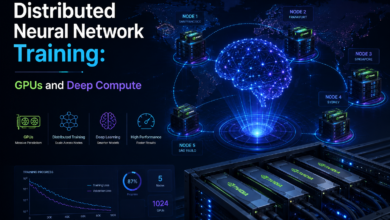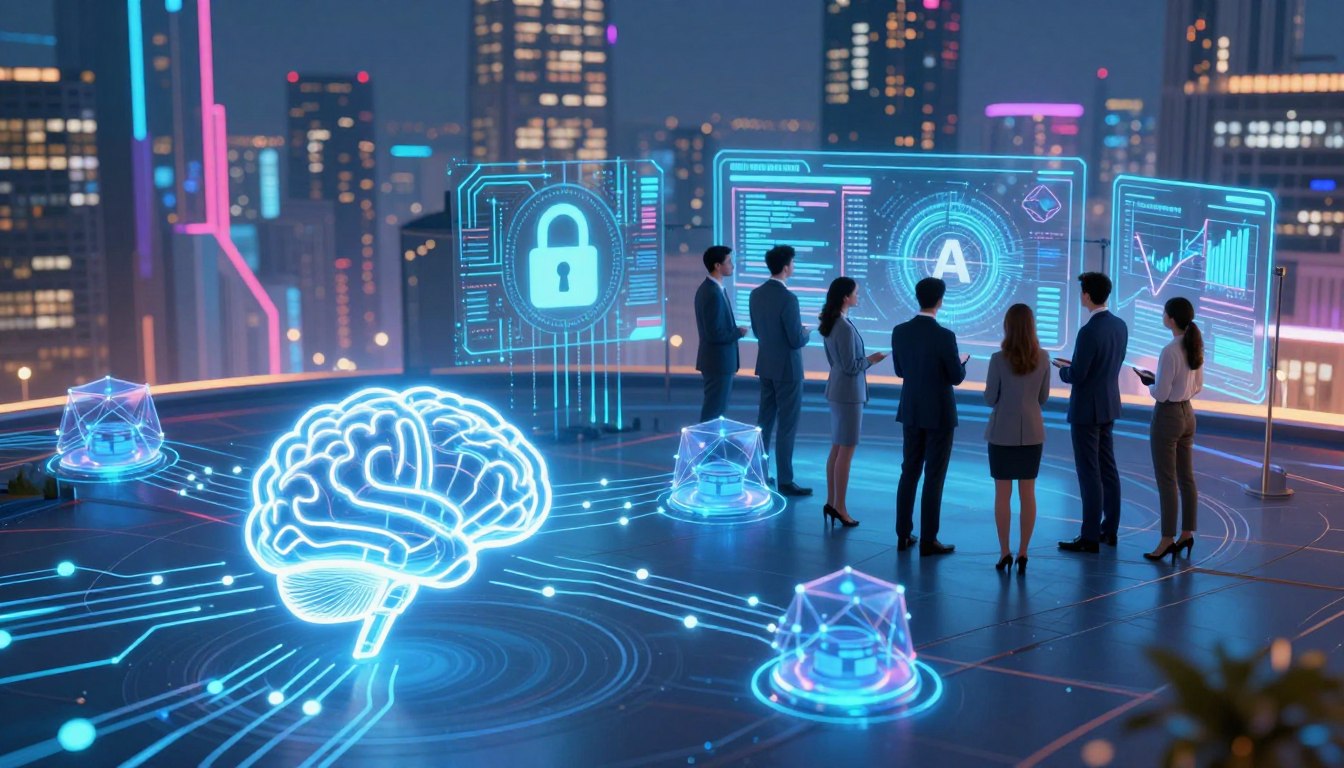
Ever thought about your money managing itself perfectly? I dive into how integrating digital ledgers with AI can change managing money. It’s a new way to handle your cash.
Companies like Kyriba use AI to make financial predictions more accurate. This makes the global market more stable.

In this guide, I’ll show how these techs protect your data. We’ll see how cybersecurity stays strong against new threats. Knowing this is key for anyone wanting to understand finance’s future.
Key Takeaways
- Machine learning improves the accuracy of cash flow forecasting.
- Digital ledgers provide a transparent foundation for financial operations.
- Combining these tools creates a more resilient economic infrastructure.
- Advanced defense mechanisms protect sensitive data from emerging threats.
- Strategic implementation of these systems optimizes overall liquidity management.
Understanding the Synergy Between AI and Blockchain
I think combining these two technologies is key for the future of finance. AI brings analytical power, while blockchain ensures everything is secure and unchangeable. Together, they create systems that are smart and safe.
Defining the core relationship
The bond between these technologies is one of mutual enhancement. The ledger keeps a clear, unalterable record. At the same time, ai models can quickly understand this data.
This team-up makes our systems more efficient. Decisions are made with solid facts, not guesses. With ai and blockchain together, the network gets a “brain” to handle all the data.
Why AI and blockchain are better together
Each tech is better with the other. Blockchain brings trust and security, while ai adds scalability and insight. This combo tackles big challenges that were once thought unsolvable.
Here are some benefits of using them together:
- Enhanced Transparency: Every algorithm decision is traceable on the ledger.
- Automated Efficiency: Smart contracts can act on data analysis in real-time.
- Improved Security: Predictive models spot threats early, protecting the network.
By using ai and blockchain, we’re not just making things better. We’re building a new way for digital interactions. This partnership ensures our financial systems are strong, open, and quick to adapt.
Setting Up Your Infrastructure for AI and Blockchain Integration
Setting up the right infrastructure is key to your success. When starting with ai and blockchain integration, make sure your base is solid and can grow. A good setup lets systems talk well and keeps data safe with blockchain.
Selecting the right blockchain network
Picking the right blockchain network is a big decision. Look for platforms that handle lots of data fast and cheaply. Efficiency is important for apps that need smart contracts and data to work together.
Check the network’s consensus mechanism and support for developers. Some chains are better for fast data, while others focus on being very decentralized. Here’s what to consider when choosing:
| Network Type | Scalability | Transaction Speed | Best Use Case |
|---|---|---|---|
| Public Layer 1 | Moderate | Slow | High Security |
| Layer 2 Solutions | High | Fast | AI Data Processing |
| Private Consortium | Very High | Instant | Enterprise AI |
Preparing your data for AI algorithms
After picking your blockchain network, focus on your data quality. Ai algorithms need good data to work well. Bad or incomplete data means bad results.
Start with a strict data cleaning process. Make sure your data is the same everywhere. Good data is what makes ai and blockchain solve big problems. Clean data is essential for your ai algorithms.
Enhancing Blockchain Security with Artificial Intelligence
I think artificial intelligence is key to better blockchain security. It helps me find threats early, before they become big problems. This is critical for keeping digital assets safe in today’s world.
Detecting anomalies in real-time
Watching network traffic for odd patterns is a big deal for blockchain security. Machine learning helps me catch suspicious activity right away. This stops hacks before they can harm a liquidity pool.
Real-time detection is more than just looking for known threats. It learns what’s normal and alerts me to anything different. This ai and blockchain combo keeps your system strong against smart attacks.
“The future of decentralized finance depends on our ability to automate defense mechanisms. AI is not just an option; it is a necessity for long-term survival.”
Predictive threat modeling for blockchain security
I use predictive modeling to stay one step ahead of hackers. Artificial intelligence looks at past data and current trends to guess where attacks might come from. This lets me fix weak spots before hackers find them.
The table below shows how this approach is better than old security methods:
| Feature | Traditional Security | AI-Enhanced Security |
|---|---|---|
| Response Time | Reactive (Post-incident) | Proactive (Real-time) |
| Threat Detection | Known signatures only | Pattern recognition |
| Scalability | Manual oversight | Automated monitoring |
| Accuracy | High false positives | High precision |
Using ai and blockchain together makes your assets safer. By focusing on predictive modeling, you turn your blockchain into a self-protecting system. This level of protection is what serious developers and investors aim for today.
Automating Smart Contract Audit Processes
Protecting your decentralized application starts with a rigorous and automated approach to security. Manual reviews alone are not enough in today’s fast world. By moving security to the left, you can find and fix errors before they hit the mainnet.
Identifying vulnerabilities before deployment
The main goal of smart contract security is to stop costly hacks. Finding vulnerabilities early saves your project from big financial and reputation losses. Early detection lets your team fix issues while the code is being developed.
Automated tools check your code for common security risks like reentrancy attacks and integer overflows. This proactive stance makes sure your deployment is both fast and secure. You’ll know your code is safe against known threats.
Using AI to streamline the audit workflow
Adding artificial intelligence to your audit workflow changes how you handle security. AI can quickly scan thousands of lines of code, spotting complex issues humans might miss. This speed lets you integrate security checks into your development process continuously.
Automating routine tasks frees up your developers to focus on improving your app’s architecture. This mix of human insight and AI precision makes your development cycle more reliable. Your team will spend less time fixing bugs and more time adding new features.
Step-by-step automated testing
To start, follow a structured testing pipeline. This ensures every smart contract gets a detailed audit before it’s ready.
- Static Analysis: Use automated tools to find syntax errors and common security issues.
- Unit Testing: Create detailed test suites to check if functions work as expected under different conditions.
- Fuzzing: Employ AI-driven fuzzers to test your functions with random data, looking for unexpected issues.
- Formal Verification: Use mathematical proofs to confirm your code’s logic is correct and unchangeable.
| Feature | Manual Audit | Automated Audit |
|---|---|---|
| Speed | Slow | Instant |
| Cost | High | Low |
| Coverage | Limited | Comprehensive |
| Consistency | Variable | High |
Optimizing Liquidity Provision Using Machine Learning Algorithms
I now use advanced tools to handle liquidity provision better. Old methods use fixed settings that don’t keep up with fast changes in finance. Machine learning helps me create a strategy that adapts quickly.
Predicting market volatility
I use ai algorithms to look at past prices and current orders. These tools spot trends that show when the market might change. This lets me adjust my investments to keep my money safe.
This skill is key to staying ahead in a changing market. When the system sees a likely price jump, it automatically changes my offers. This keeps my liquidity profitable, even when the market is unpredictable.
Dynamic rebalancing of liquidity pools
I have a strong ai model for managing my pool assets. It learns from the market in real-time, making sure my money works well. This means I don’t need to do it manually, which is too slow for blockchain.
The table below shows how these smart strategies beat old, fixed ways in a typical market.
| Feature | Static Strategy | AI-Driven Strategy |
|---|---|---|
| Risk Management | Manual/Reactive | Automated/Predictive |
| Rebalancing Speed | Delayed | Real-time |
| Capital Efficiency | Moderate | High |
| Market Adaptation | Limited | Continuous |
The main goal of using ai is to make more money while taking less risk. By automating rebalancing, I keep my liquidity provision top-notch all the time. This level of efficiency is beyond what humans can do alone.
Strengthening Data Privacy and Data Security Protocols
Building trust with users starts with strong data privacy and data security measures. In decentralized systems, old defense models don’t work. You need a new strategy to protect sensitive info at every level.

Applying encryption techniques
To keep your data safe, use advanced encryption. Homomorphic encryption is key because it lets you work on encrypted data without decrypting it. This keeps your info safe during processing.
Zero-Knowledge Proofs (ZKPs) are also powerful. They let you prove something is true without showing the data. This boosts your data security while keeping things transparent.
Ensuring compliance with data privacy regulations
It’s as important to follow the law as it is to use the right tech. Make sure your systems meet global standards like the GDPR or CCPA. Not following these can hurt your reputation and lead to legal trouble.
Regular audits are key to keeping your data privacy up to date. Document how you handle user info and provide clear reports. This way, you can use blockchain safely and protect your users.
| Security Method | Primary Benefit | Best Use Case |
|---|---|---|
| Homomorphic Encryption | Privacy-preserving computation | Cloud-based AI analysis |
| Zero-Knowledge Proofs | Verifiable anonymity | Identity verification |
| AES-256 Encryption | Standardized data protection | At-rest storage |
| Multi-Signature Wallets | Enhanced access control | Asset management |
Implementing Decentralized Solutions for Supply Chain Management
I think you can make your operations better by decentralizing your logistics. Moving away from single databases makes your supply chain stronger. It can handle sudden global problems better.
This change makes your supply chain more flexible. It helps you move goods quickly across borders. Integrating these systems gives you an edge in today’s fast market.
Tracking assets with blockchain technologies
Using blockchain technologies to track assets brings unmatched visibility. Every move is recorded in real-time. This means no more manual checks.
This ensures you always know where and what your inventory is. Immutable records let you check goods’ authenticity from start to finish.
Improving transparency in supply chain management
Making your supply chain management more transparent builds trust. When all can see the same data, fewer disputes happen. This is because everyone has the same information.
This open way of sharing info creates a culture of truth and efficiency. It lets partners see the whole supply chain journey. This boosts your brand’s reputation over time.
| Feature | Traditional System | Blockchain-Enabled |
|---|---|---|
| Data Access | Centralized/Siloed | Distributed/Shared |
| Record Integrity | Editable/Prone to Error | Immutable/Verified |
| Visibility | Limited/Delayed | Real-time/End-to-end |
| Trust Level | Requires Intermediaries | Built-in via Code |
Establishing Robust Security Standards for Blockchain Networks
I think setting clear security standards is key for a successful blockchain network. Without a strong framework, even the most creative projects can face big security risks. By focusing on security and transparency from the beginning, you build a strong base that lasts.
Defining industry-wide security and transparency benchmarks
To succeed in the long run, every project should aim to meet industry standards. These benchmarks help keep your blockchain technologies safe and strong against threats. Here are the main areas to focus on for top-notch blockchain security:
- Regular Audits: Do third-party code checks often to spot weak spots.
- Open Transparency: Share detailed info on how your system works and is managed.
- Standardized Testing: Run tough tests to see how your system holds up under attack.
Best practices for maintaining network integrity
Keeping your blockchain network safe needs constant effort and smart management. Just building a secure system once isn’t enough. You must always watch for unauthorized access and data changes. Here are some best practices to keep your system safe:
- Multi-Signature Wallets: Need more than one person to agree on big actions to avoid single failures.
- Automated Monitoring: Use AI tools to spot odd behavior in your blockchain right away.
- Encryption Protocols: Use top-notch encryption to keep data safe when it’s stored or moving.
By sticking to these tips, you can create a trustworthy environment for your users. Improving your blockchain security is a never-ending task, but it’s the best investment for your project’s future.
Managing Data Integrity in Blockchain Transactions
The base of a secure digital ledger is its accurate data. Keeping data integrity is key for a trustworthy blockchain transaction system. Without it, the whole system could lose user trust.

Verifying transaction accuracy
Looking into network functions, I see how checking transaction accuracy stops big financial losses. Every smart contract must work as planned to keep the ledger right. By using strict verification, I cut down the chance of mistakes or system failures.
These checks protect your digital assets. They make sure every entry is correct before it’s added to the chain. This is crucial for keeping decentralized finance stable over time.
Preventing fraud with AI-driven validation
I also use machine learning for better security through smart validation. This tech spots odd activity fast, better than manual checks. By learning from past data, it catches threats early.
This smart layer keeps your transactions safe and accurate always. It watches the network closely. By using these tools, I stay ahead of bad actors in the digital world.
Scaling AI Models for Real-Time Blockchain Analytics
Scaling an ai model for fast blockchain analytics is key in today’s markets. I build systems that handle big data quickly and accurately.
Deploying models on decentralized infrastructure
Switching from central servers is vital for blockchain and ai developers. Decentralized networks keep your tools up and running always.
Theoriq is a good example, raising over $10.4 million for decentralized ai agent collectives. This shows the industry’s move towards decentralized systems.
Handling high-frequency data streams
Blockchain data updates fast and constantly. Your ai model must sift through this to find important patterns quickly.
I suggest using asynchronous processing for big data. This keeps your ai fast, even when markets are wild. It makes your ai a trusted tool for quick decisions.
Overcoming Challenges in AI and Blockchain Deployment
Merging blockchain and machine learning is not easy. The mix of these complex systems can face many hurdles. My aim is to guide you through these challenges, keeping your project strong and effective.
Addressing technical limitations
One big challenge is managing data flow. For example, high-frequency traders might struggle with fast market changes. Latency issues can slow down their trades, leading to missed chances.
Also, training an ai model needs a lot of data. This can overwhelm traditional network nodes. You need to make sure data flows well without slowing down the system.
“Innovation is not about avoiding problems, but about building the tools to solve them effectively.”
— Anonymous
Balancing decentralization with performance
The main challenge is balancing decentralization with speed. True decentralization can slow down transactions. You must choose which parts need full decentralization and which can be faster.
It’s an art to find this balance. Too much focus on speed can harm security. But too much on decentralization can slow things down too much.
| Challenge | Impact | Mitigation Strategy |
|---|---|---|
| Network Latency | High | Layer-2 Scaling |
| Data Throughput | Medium | Off-chain Processing |
| Volatility Response | High | Predictive Algorithms |
| Security Trade-offs | Critical | Hybrid Architectures |
Choosing the right infrastructure is key. It helps make your system secure and fast. Remember, how well you decentralize will decide your project’s success. Focus on these trade-offs to make your platform stand out.
Conclusion
I have shown you how to mix artificial intelligence with blockchain. Now, you know how to make systems more secure, improve how money moves, and make things clear.
Begin with small projects. This way, you can learn as you go. It’s all about trying these tools in real life and getting better with each try.
The world of finance is always changing. You have the tools to help make it better. Start using these ideas in your projects now. Your work will help build a safer and more efficient financial world.
FAQ
How does artificial intelligence help me manage liquidity on a blockchain network?
By using an ai model, I can automate how capital is used in decentralized markets. Machine learning helps me predict market changes on platforms like Uniswap. This way, I can make the most money while taking less risk.This keeps my blockchain transaction activities up to date with the market.
Why do ai and blockchain create a more resilient framework for modern finance?
They work well together because of their strengths. Blockchain technologies keep records safe and data integrity intact. Artificial intelligence helps make sense of big data.Together, they help me build systems that are both open and very smart.
Can I use ai algorithms to perform a smart contract audit?
Yes, and I highly recommend it. I use artificial intelligence for a detailed audit. This helps me find code problems before they cause trouble.This step is key to keeping blockchain security strong and protecting user money.
How does supply chain management benefit from a decentralize ledger?
A blockchain makes product history clear and unchangeable. This helps brands like IBM Food Trust and Maersk improve their logistics. It also keeps data security strong across the supply chain.This makes supply chain management more efficient and less likely to have mistakes.
What is the best way to handle data privacy when using an ai model on a public blockchain?
I use zero-knowledge proofs and strong encryption. My goal is to meet data privacy rules while letting ai algorithms work. By keeping data processing decentralize, I protect identities without losing ai model power.
How do I maintain data integrity during a high-volume blockchain transaction?
I use ai-driven validation to check data accuracy in real-time. This stops fraud and keeps the blockchain network reliable. It ensures the ledger’s data integrity is always perfect.
What are the main hurdles when I choose to decentralize my ai model infrastructure?
I face a challenge between speed and security. A decentralize network is safer but can be slower. I solve this by making my machine learning code better and choosing a fast blockchain network like Solana or Polygon.
How does blockchain security evolve with the help of artificial intelligence?
I use predictive threat modeling to stay ahead of threats. By training an ai model on past attacks, I strengthen blockchain security. This makes the blockchain network more resilient against cyber threats.
How can I scale my artificial intelligence tools for real-time analytics?
I recommend using a strong, decentralize setup like Render or Akash Network. This lets me handle lots of data quickly. It ensures my ai algorithms give timely insights for every blockchain transaction without slowing down.