
Introduction: The Convergence of Decentralization and Intelligence
The internet as we know it is undergoing a radical metamorphosis. If Web2 was the era of centralized platforms and data harvesting, and early Web3 was the era of decentralized ownership, then the emerging Web3-AI Hybrid is the era of Decentralized Intelligence.
At OmniBlockAI, we track the invisible threads connecting these two massive technological shifts. Neural Networks (the brain of AI) and Web3 (the nervous system of decentralization) are merging to create a persistent, intelligent, and ownerless digital reality. This guide explores the architectural blueprints of this new internet and why this convergence is the most important technological event of the late 2020s.
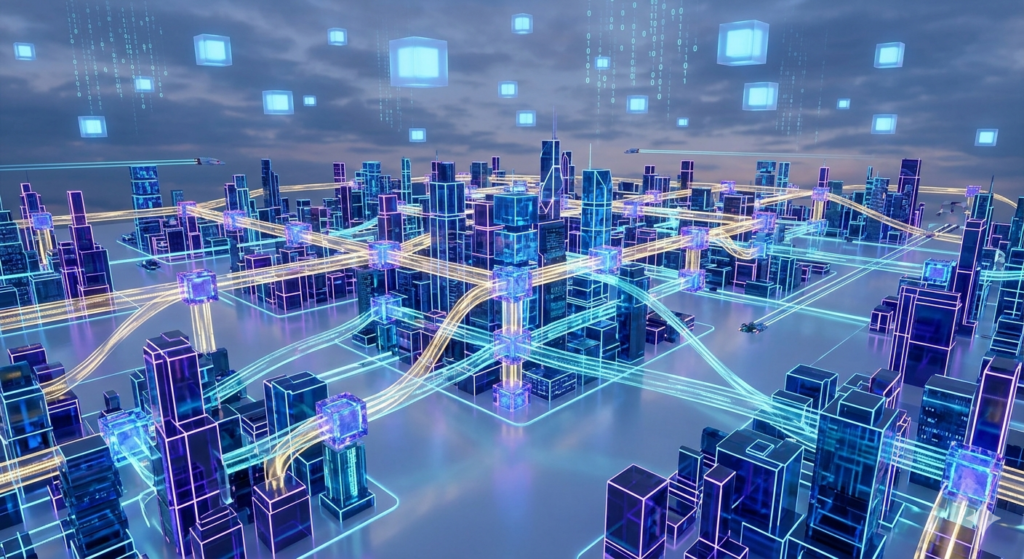
1. The Philosophical Shift: Why AI Needs Web3 (and Vice Versa)
To understand the architecture of the future, we must first understand the fundamental synergy between these two technologies.
A. AI’s Centralization Crisis
Currently, AI is controlled by a handful of “Big Tech” conglomerates. They own the data, the compute power, and the models. This creates a “Black Box” where the public has no say in how AI is trained or used. Web3 provides the solution: Decentralized Compute (DePIN) and Verifiable Training.
B. Web3’s Usability Crisis
Early Web3 was clunky, difficult to navigate, and prone to human error (losing keys, sending funds to the wrong address). Neural Networks provide the “Intelligent Interface” needed to make the blockchain invisible and intuitive for the average user.
2. Building Blocks: The Layers of the Intelligent Internet
The architecture of the future internet can be visualized in four distinct layers, each integrated with neural network capabilities:
Layer 1: The Decentralized Compute Layer (The Muscles)
AI training requires massive GPU power. Projects like Render and Akash allow anyone to contribute their idle GPU power to a global network. Neural networks can now be trained across thousands of individual nodes rather than in a single data center.
Layer 2: The Data Privacy Layer (The Memory)
In the future internet, you won’t give your data to a platform. You will store it in a decentralized vault (like Filecoin or Arweave). AI models will travel to your data, learn what they need, and provide a service without ever “seeing” your personal information, thanks to Zero-Knowledge Proofs (ZKPs).
Layer 3: The Protocol Layer (The Logic)
This is where Smart Contracts meet Inference. Instead of static code, we are seeing “Neural Contracts”—smart contracts that can change their behavior based on real-time AI analysis of the market or user behavior.
Layer 4: The Agent Layer (The Interface)
The browser of 2026 isn’t a search bar; it’s a Personal AI Agent. This agent lives on the blockchain, manages your private keys, negotiates with protocols for the best interest rates, and filters the internet based on your preferences.
3. Neural Networks on the Blockchain: Technical Challenges
At OmniBlockAI, we don’t just hype the tech; we analyze the hurdles. Running a neural network on-chain is computationally expensive.
Solutions in 2026:
- Optimistic ML: Performing the AI calculation off-chain and only posting a “proof” on-chain.
- zkML (Zero-Knowledge Machine Learning): A revolutionary tech that allows an AI to prove that its output was generated by a specific model without revealing the model’s weights.
4. Case Study: The Autonomous Meta-Economy
Imagine a decentralized YouTube where the “Algorithm” is not controlled by a corporation but is a neural network owned by the creators themselves (via a DAO).
- The AI manages content distribution fairly.
- The Blockchain manages the payments instantly.
- The Users own the data.
This is not a dream; it is the architectural goal of projects we cover in our The Convergence section at OmniBlockAI.
5. The Impact on Human Society: The “Omni-Digital” Life
As Web3 and Neural Networks merge, the boundaries between the physical and digital worlds blur.
- Self-Sovereign Identity: Your AI agent can prove you are a human over 18 without revealing your name or birthday.
- AI-Gated Communities: DAOs where entry is granted by an AI that evaluates your contributions to the ecosystem rather than just your bank balance.
6. Security in the Intelligent Web
With great power comes great vulnerability. The future internet faces “Neural Attacks” where malicious actors try to poison the data used to train decentralized models. At OmniBlockAI, we emphasize the importance of Immune System Protocols—AI agents whose sole job is to hunt for malicious code in the decentralized web.
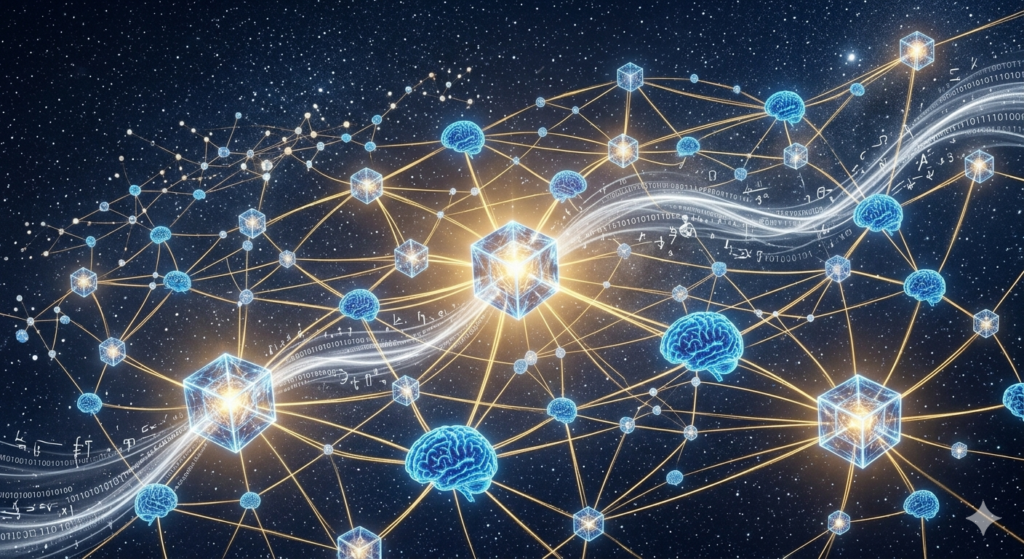
7. Conclusion: Your Role in the Architecture
The architecture of the future internet is still being written. We are moving from a web that serves us to a web that understands us—and most importantly, a web that we own.
At OmniBlockAI.blog, our mission is to provide the blueprints. Whether you are building the next Layer 2 or simply trying to understand how to protect your digital assets, you are an architect of this new world.
The convergence of Web3 and Neural Networks is not just a technical update; it is a declaration of digital independence.
FAQ: Deep Dive into Web3 & AI
1. What is zkML and why is it important? zkML (Zero-Knowledge Machine Learning) allows an AI to prove it performed a calculation correctly without revealing the sensitive data used. It’s the key to privacy in the intelligent web.
2. Can AI live entirely on the Ethereum blockchain? Currently, no. The cost of storage and computation is too high. Most AI-Web3 hybrids use “Off-chain computation” with “On-chain verification.”
3. Will AI agents replace wallets? Yes. In the future, you won’t interact with long hexadecimal addresses. You will tell your agent “Pay for my coffee,” and it will handle the blockchain transactions in the background.
4. How can I invest in the Web3-AI architecture? Look into “Infrastructure” projects—those providing the compute (DePIN), the storage, and the privacy layers.